Does the inequality in wealth between the world’s regions simply reflect a difference in Africa’s natural resources and the rest of the world’s?
No. Contrary to many stereotypes, many African countries have among the best and most in-demand natural resources in the world.
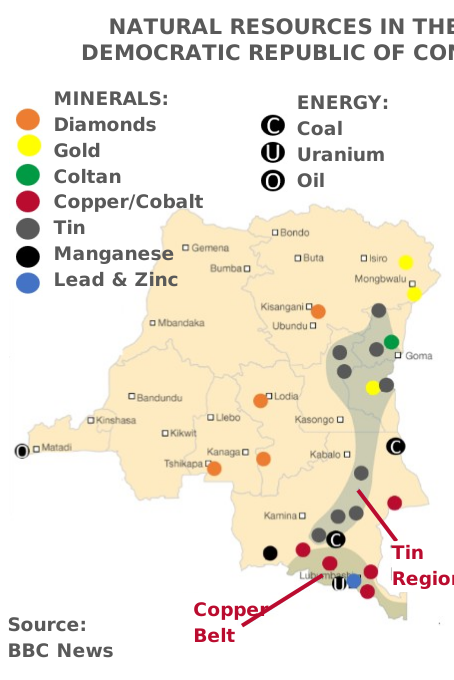
Example: Democratic Republic of the Congo
The Democratic Republic of the Congo is in the top 12 countries in the world with the most natural resources [1].
The DRC produces 12 percent of the world’s diamonds [2] , 80 percent of all the world’s supply of coltan, an ore crucial in electronics, [3] and 70 percent of the world’s cobalt [4] which is used in laptop, phone and car batteries.
The DRC has helped power the global tech boom that has added trillions to global growth [5]. Yet the profits are made elsewhere, and the government of the DRC has so little money that many of its children are forced to work in the dangerous mines themselves [6].
It is the same story across the continent. Zambia is one of the world’s top ten copper-producing countries [6], Mali one of the top twenty gold-producing countries [7], and Tanzania is one of the world’s top ten diamond-producing countries [8].
Africa is home to 30 percent of the world’s mineral reserves, including up to 90 percent of its chromium and platinum [9]. But with much of the profit moved offshore by foreign companies, African governments are left with insufficient funds for education and other basic services.
More Profits from African Resources, More Poverty for Young Africans
More of Africa’s natural resources are being used in the global economy.
The increase in money being made from African natural resources since the start of the SDGs in 2015 is a third of a trillion [11] US dollars with major increases in many countries
Yet in the same six years, over 10 million more African children are out of school , 20 million more African children are in child labour [12], eight million more African childrenare living in extreme poverty [13] and 40 million more African childrenare going hungry [14]
So why aren’t Africa’s natural resources benefiting Africans?
1. Insider Monkey (10th October 2023) ‘Top 8 countries with most natural resources’ lists DRC as number 3. Read more here
2. Mining-Technology.Com derived from GlobalData, Diamond production in the Democratic Republic of the Congo and major projects. “The Democratic Republic of the Congo accounts for 12% of global production”. See more here
3. University of WaterlooEarth Sciences Museum, Coltan “Where it is found: Democratic Republic of Congo (80%)”. See more here
4. Professor Dorothée Baumann-Pauly, Council for Foreign Relations (October 2020). Why Cobalt Mining in the DRC needs urgent attention? “More than 70 percent of the world’s cobalt is produced in the Democratic Republic of the Congo (DRC)” See more here
5. PWC, Strategy& ‘Becoming a digital disruptor’ estimates the digital economy will reach 25% of global GDP by 2025 (which will be over $25 trillion) – Read more here
6. Amnesty International, “THIS IS WHAT WE DIE FOR” HUMAN RIGHTS ABUSES IN THE DEMOCRATIC REPUBLIC OF THE CONGO POWER THE GLOBAL TRADE IN COBALT’, (2021), Read more here
7. Investingnews.com (September 2021) ‘Top Copper Production by Country’ Read more here.
8. World Gold Council (June 2021) ‘Mine production’ Read more here
9. BizVibe (2020) ‘Top 10 Diamond Producing Countries in the World 2020’, Read more here
10. United Nations Environment Programme (accessed 12 October 2022), ‘Our Work in Africa’ – Read more here
11. World Bank, Total Natural Resource Rents (% of GDP), Indicator NY.GDP.TOTL.RT.ZS – Get data here & GDP (constant 2015 US$) Indicator, NY.GDP.MKTP.KD – Get data here
12. International Labour Office and United Nations Children’s Fund (2021) ‘Child Labour: Global estimates 2020, trends and the road forward’, ILO/UNICEF New York – Get data here gives 92,200,000 for Africa child labourers in 2020 (latest year) & International Labour Office (2017) ‘Global Estimates of Child Labour: Results and trends, 2012-2016’ ILO Geneva – Get data here ; gives 72,113,000 for Africa for 2016 – an increase of 20,087,000.
13. World Bank and UNICEF ‘Global Trends in Child Monetary Poverty According to International Poverty Lines’, (Accessed in 2023) – Read more here – gives the number of children living on $2.15 a day from 2017-2022) and the % and number in 2022 that were from sub- Saharan African (71.1% and 237.03 million) & World Bank ‘Global Estimate of Children in Monetary Poverty: An Update’ – Read more here – gives a % share for sub-Saharan Africa in 2017 of 65.8% for the $1.90 poverty level. Using this percentage gives sub-Saharan African children living under $2.15 a day as 229 million in 2017, so an increase in 8 million from 2017-2022. (Also World Bank ‘Projections for African adults from Poverty and Inequality Platform Poverty Calculator – Population living below the poverty line (2017 PPP)’ – Read more here gives 385 million in sub-Saharan Africa for 2015 and 444 million for for 2021 showing an even larger increase of over 57 million).
14.FAO,’ Number of undernourished people (millions)’ – Get data here – gives 175.8 million people for 2015 and 260.6 for 2021 giving an increase of 84.8 million people . An estimate using the same proportion of children as those living on less than $2.15 in sub-Saharan Africa (52.4%) from World Bank and UNICEF ‘Global Trends in Child Monetary Poverty According to International Poverty Lines’ – read more here, gives an estimate of 45 million more children.