DEBT JUSTICE: WHAT CAN BE DONE?
Step 1: Immediate Debt Cancellation
This is the worst debt crisis there has ever been for developing countries. [1]
With repayments increasing even more in the coming years the debt is so unsustainable that it will have to be cancelled. The only question is how many will suffer, and for how long, before it is?
The IMF must now complete the pandemic SDR allocation by ringfencing a balancing one off issue for low- and lower-middle income countries, that tops up their emergency SDR allocations to match the $361 per person high income countries received in 2021. [2]
This would provide enough financing to cancel all the low-income country debt and 10% of lower middle-income debt in Africa. [3]
It would also have less than 5% of the impact on global money supply than rich countries’ quantitative easing did so it is economically feasible. [4]
Even the high income countries will benefit from the boost to the global economy and there is a powerful moral case given it was the choices that high income countries made that turned the debt to crisis levels.
Cutting Africa out of the global pandemic response was a choice the Western world made, allocating almost all the emergency Special Drawing Rights to richer countries was a choice the Western world made, Quantitative Easing was a choice the Western world made, invading Ukraine was a choice Russia made and enforcing unrepayable loans in a continent where malnutrition has increased from 176 million to 298 million in a decade [5] is a choice the Western world and China are making .
From Egypt to Mozambique, from Ghana to Kenya, African countries and African children have been hit hard. It is time for the IMF to recognise the debt crisis was not caused by reckless borrowing but by the sidelining of Africa during the pandemic. It is time to write down the money owed and reset with a balancing SDR issue. It is time to cancel the debt.
Step 2. International Debt Reform and a Sovereign Debt Default Mechanism
As well as cancellation, reform to the debt system must be made to prevent future crises. Countries need to be able to borrow money, but there must be changes in how sovereign debt is managed and guaranteed.
GDP per person has been falling in sub-Saharan Africa in the last decade so clearly the loans did not deliver growth or at least sufficient growth to outweigh the impact of the external crises Africa faced. [6] When investments in business do not work out, investors lose money, the same must apply to investments in countries.
Whereas companies and individuals can go bankrupt, there is nothing to restructure sovereign debt in the way corporate bankruptcy laws and judicial processes can restructure debt (such as a Chapter 11 in the US). A sovereign debt restructuring mechanism (SDRM) was proposed in 2003 at the IMF but not agreed. [7]
Some of the debt was not even borrowed in a transparent and democratic manner such as in Mozambique. It should be a simple rule that future citizens of a country only pay back debt if it was approved by the legislature and published at the time.
For sovereign debt to be repayable by future citizens it must be published at the time and approved by the correct authority. There needs to be a publicly accessible registry of loan and debt data created and housed in a permanent institution and debt courts in high income countries should not enforce any debt which was borrowed incorrectly.
A framework for collaboration is also needed, the G20 debt initiative has failed, in part because of their inability to coordinate across the broad range of creditors.
To stop a debt crisis recurring in future, a sovereign debt mechanism must be established for bankrupt countries. It will slightly increase the price of future borrowing as lenders price in risk, but it will help ensure no more generations are trapped for decades with unsustainable debt.
It is also important to address three other critical reforms:
- When the IMF acts as a central bank for the world in issuing emergency SDRs in the future, it must be distributed fairly by population not by IMF voting power. A change in IMF articles of agreement needs to be amended along with other democratic reforms
- The G20 central bank meeting must consider the impacts of their policies on low-income countries and include poorer countries in all future global responses to crises. Increasing the global money supply in only the richest countries, will have an impact on the economies of lower income countries that must be both considered and when needed mitigated by a percentage of the liquidity raised.
- The IMF and World Bank need to prioritise the needs of low-income countries and act in their best interests, including supporting debt cancellation when it is necessary and has been caused by external factors. Profligate government spending does require better budget management, but dictators borrowing money undemocratically, reckless lending by creditors and internationally caused crises cannot be used to trap generations of young Africans in debt slavery.
At the moment the World Bank offers advice that is bordering on patronising, “the challenge [for poorer countries] is to redirect spending to areas in need” and “improving government spending efficiency” [8].
When countries have a tiny percentage of the government budget per person of high-income countries, and have faced crippling debt repayments for several years whilst the richer countries that drove much of this crisis only protect themselves, it’s an understatement to say this advice is not that useful.
To fulfil their role, the World Bank and the IMF must champion the needs of developing countries not the richest.
Step 3: National Debt Action: Reject Unjust Debt, Don’t Cede Control, Get Smarter
At the moment, the response of many indebted African countries has been to overwhelmingly focus on how to pay an ever-increasing share of the government budget to creditors.
Countries could be a lot more assertive in rejecting unjust debt that wasn’t properly approved by parliament or that was used for corrupt purposes or is simply unpayable.
There can also be a stronger rejection of the IMF control until it reforms.
If the IMF wants to bailout Western creditors and offer African countries longer term financed debt they can. However the deals are not so important that Africa should cede control of our countries future back to Western controlled officials. IMF staff fly in from another country and have no connections with the communities that will be affected by their decisions, so even when their motivation is genuine major mistakes are made.
In terms of the debt with private bondholders, more governments could make greater use of the African Legal Support Facility’s support on debt and the protection it offers against vulture funds and exploitative companies. As with the negotiations on tax, better contracting will help for the future. With a broader range of actors involved in sovereign debt, going into contracting as prepared as possible is vital to secure a better deal for Africa’s future.
African Governments and civil society also need to recognise the role international policies have played in creating this debt crisis, how the international markets are rigged and be more firm in challenging this.
The international injustices during the COVID pandemic, rich country quantitative easing and the discrimination in Special Drawing Rights allocations made the debt unpayable so those responsible bear some of the responsibility.
Above all African central banks need to recognise when they have to break the cycle of increasingly expensive debt refinancing – as they would say in the US sometimes it is time to stop kicking the can down the road.
When the debt reaches unrepayable levels it is time to face the fact that debt cancellation will be necessary.
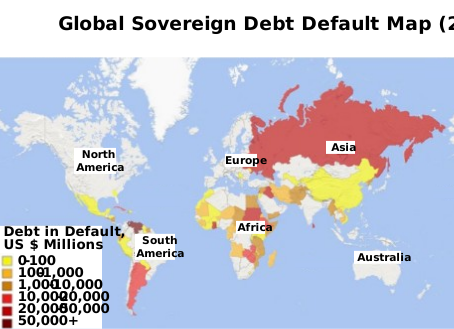
Many countries default on sovereign debt for various different reasons – hundreds of countries have done it in their history, many without facing the dire situation of extreme poverty or the levels of unsustainable debt many African countries are facing today.
As the map, from the Bank of Canada and the Bank of England’s sovereign debt default database, shows sovereign default is global. Last year just 26% of the sovereign debt defaulted was by sub-Saharan African countries despite the overwhelming impact of the debt crisis falling on Africa. [9]
Each country has different circumstances, but just because the IMF and World Bank’s shareholders try to avoid debt default it doesn’t mean that some African countries shouldn’t evaluate it as an option. When considering whether to take the extension of debt and IMF control that comes with a bailout African governments need to consider all options and remember the bailouts are to the creditors as much as Africa.
Step 4: African Debt Response: Common African Position on Debt
In a world where international agreements are being broken and sidelined, and more powerful countries are seeking to bully others into accepting unfair policies, it is vital for Africa to work together.
On debt where the G20’s inaction has been so stark and the crisis has escalated so severely this is even more true. Debt servicing payments are half of government revenues for some countries and total $2.4 billion a week across sub-Saharan Africa three and a half times more than is received in aid even before the latest cuts – if we don’t act together now then when? [10]
The African Debt Leaders initiative is an excellent start and they and the new African Union leadership have a critical role to play in charting a path for Africa out of this debt crisis.
Raising awareness across Africa and globally about the international drivers of the debt crisis is an important first action. The African Central Bank and others can use their policy making ability to develop a thorough analysis of the international causes of the debt crisis that can form the basis of negotiations with other regions in the world.
Secondly, it is vital that a common African position is reached. Together Africa has much more negotiating power. As we have seen with the UN tax convention, when Africa acts together it has a far greater chance of success in international negotiations and securing backing from other countries.
The threat of an African wide default would give African countries much greater leverage in negotiations, a critical factor in the debt write downs in countries such as Argentina and Brazil in the past.
Comparing Africa’s share of global sovereign debt default (26%) with Africa’s share of the number of children living in a debt distress country (97%), shows how small Africa’s share of sovereign default currently is when compared to its share of the crisis. [11]
A comparison with the Greek debt crisis in 2012 is also revealing. Greece has 1% of the population of the African countries at medium or high risk or already in debt default today. [12] The Greek sovereign default in 2012 was $312 billion, more than twice the size of current sub-Saharan African sovereign default [13] but crucially there was a huge difference in the political will to resolve the crisis.
Although many Greeks were harmed by the crisis response (and in typical fashion the IMF led restructuring caused a recession in Greece which deeply worsened the GDP to debt ratio), the speed and scale of the funding provided shows what could be done.
In February 2012 the Greek government passed a law that forced a ‘haircut’ [14] on all private sector debt holders unless there was 50% bondholder opposition. [15] The private this led to write-down on private sector debt of Euro 107 billion in March 2012 [16], an amount that would be transformative in Africa today.
The real benefit to Greek debt was less but nevertheless this demonstrates what can be done to end private sector bondholders trapping a country in debt in perpetuity when there is genuine political will.
Any discussions on debt action are diffcult for any one African country to consider but together there are more possibilities.
United African action will also increase the chances of structural reforms being agreed for the future such as the sovereign debt default mechanism and the chance of finally receiving justice in the Special Drawing Rights allocations with a new emergency IMF issue.
African leaders need to take the final decisions on repayment, and these are complicated matters, but what is clear is the status quo cannot continue. The debt is unrepayable.
It is time to stand together to stop another generation of young Africans being trapped in debt slavery, under the control of the very same rich countries and companies whose policies created the debt crisis and who continue to exploit Africa’s resources.
Debt Justice is affordable, possible and is critical to the future of Africa and indeed the world. It is time for Debt Justice Now!
Sources
1. World Bank ‘International Debt Report’ (December 2023) Read more here – “,Debt service payments by LMICs are the highest level in history, and are forecast to continue to grow”. & Development Finance International, with AFRODAD, Debt Justice, Erlassjahr, EURODAD, LATINDADD and Norwegian Church Aid ‘THE WORST EVER GLOBAL DEBT CRISIS’ (11th October 2023) – Read more here
2. International Monetary Fund ‘2021 General SDR Allocations’ – Get data here & World Bank ‘Indicator: Population, Total SP.POP.TOTL’ – Read more here give the allocation of emergency SDRs to high income countries in 2021 as the equivalent to $361/person. To rectify the discriminatory allocation of global liquidity, the emergency SDR issue should be completed with a balancing issue to take other countries to the same per person allocation – this would be worth $1.21 trillion for low and lower middle income countries and $2.02 trillion if upper middle countries were included too.
3. International Monetary Fund ‘Central Government Debt Percent of GDP – CG_DEBT_GDP@GDD’ Get data here & WORLD BANK GDP (current US$) NY.GDP.MKTP.CD’ Get data here gives a calculation for all low and lower middle income countries with data & WORLD BANK ‘Indicator: Population, Total SP.POP.TOTL’ – Get data here – can be used to weight the income classifications for countries missing data by % population in the countries with data. This gives current debt as $789 billion for low income countries and $4,115 billion for lower middle income countries so the low and lower middle income country SDR issue is equivalent to 100% of low income and 10% of lower middle income countries debt. Because the debt is rising fast, this is less than a similar SDR issue would have cancelled in 2021 (which was all low income debt and approximately half lower-middle income debt)
4. TradingView, ‘Global (World) Monetary Supply M2 (measured in SD)’ – Get data here – Comparing $79 trillion in March 2020 with $103 trillion in 2022 so an increase of $24 trillion meaning a balancing SDR issue of $1.21 trillion would have 5% of the impact on money supply
5. Food and Agriculture Organisation of the United Nations, FAO STAT ‘Number of people undernourished (million) (annual value)’ – Get data here – for Africa gives 176,100,000 for 2013 and 298,400,000 for 2023 (Latest Year)
6. WORLD BANK ‘GDP per capita (constant 2015 US$) – NY.GDP.PCAP.KD’ Get data here shows a fall in GDP per Capita of $46 (-3%) between 2014 and 2023. In contrast many commentators feel there is a drift to nationalism in Europe, UK and the US because growth has been too slow yet their GDP per capita have increased by $4,530 (+15%), $2,986 (+7%) and $10057 (+18%) respectively
7. IMF ‘Legal and Policy Development and Review Departments Paper, Proposed Features of a Sovereign Debt Restructuring Mechanism’, (12th February 2003), Read more here
8. World Bank, ’ International Debt Report 2023’ (©Washington, DC: License: CC BY 3.0 IGO) Read more here
9. Bank of Canada ‘BoC–BoE Sovereign Default Database: What’s new in 2024?’ – Get the date here gives 25.9% of 2023’s debt in default as from sub-Saharan African countries.
10. OECD ‘Preliminary official development assistance levels in 2024’ – (16th April 2025) – Read more data here states “Preliminary estimates in 2024 show that net bilateral ODA flows from DAC members … to sub-Saharan Africa was USD 36 billion” & World Bank ‘International Debt Statistics 2024’ – Get data here {Select on left hand side: Country – ‘Sub-Saharan Africa (excluding high income); Counterpart-Area – ‘World’; Series – ‘Debt service on external debt total (TDS, current US$)} shows $127.4 billion for 2024. This means sub-Saharan African low and middle income countries paid three and a half times more in debt servicing payments than they received in bilateral aid in 2024.
11. Bank of Canada ‘BoC–BoE Sovereign Default Database: What’s new in 2024?’ – Get the data here gives 25.9% of 2023’s debt in default as from sub-Saharan African countries & IMF ‘List of LIC DSAs for PRGT-Eligible Countries (31st March 2025)’ – Get data here – gives a list of countries by debt assessment & United Nations Data Portal Population Division ‘Population by 1-year age groups and sex’ {Add together ages 0-17} gives totals for children in each country for 2024.
12. IMF ‘List of LIC DSAs for PRGT-Eligible Countries (31st March 2025)’ – Get data here – gives a list of countries by debt assessment && World Bank ‘Indicator Population, total, SP.POP.TOTL’ – Get data here – gives total population for 2024. This gives 917 million Africans living in a country in medium or high risk or already in debt distress, compared to Greek population of 10.4 million.
13. Bank of Canada ‘BoC–BoE Sovereign Default Database: What’s new in 2024?’ – Get the data here shows Greek debt default in 2012 alone of $312 billion 230% higher than the current total for all of sub-Saharan Africa put together.
14. A haircut is used to describe an event when creditors are forced by the debtor to accept a reduction in value on the money due (When bondholders propose a change in terms of debt it is called a “restructuring”)
15. Peterson Institute for International Economics, Jeromin Zettelmeyer, Christoph Trebesch, and Mitu Gulati ‘The Greek Debt Restructuring: An Autopsy’ (2013)- Read report here – p.11 “Instead, the Greek legislature passed a law (Greek Bondholder Act, 4050/12, 23. February 2012) that allowed the restructuring of the Greek-law bonds with the consent of a qualified majority, based on a quorum of votes representing 50 percent of face value and a consent threshold of two-thirds of the face-value taking part in the vote. Importantly, this quorum and threshold applied across the totality of all Greek-law sovereign bonds outstanding, rather than bond-by-bond……the sheer size of what it would have taken for bondholders to purchase a blocking position made it near impossible for individual bondholders (or coalitions of bondholders) to block the restructuring…Greece gave its creditors just two weeks, until March 8, to accept or reject the offer. This tight deadline was needed to complete at least the domestic-law component of the exchange before March 20, when a large Greek-law bond issue was coming due for repayment. “
16. European Stability Mechanism, ‘Debt relief: What was the private sector debt restructuring in March 2012?’ Get data here – estimates a Euro 107 billion reduction in Greece’s debt stock from the March 2012 restructuring of Greek debt held by private investors.
Sources
REFERENCES:
1. IMF ‘IMF Executive Directors and Voting Power’ (28th June 2024), Get the data here
2. Open Democracy, “It’s time to end the gentleman’s agreement – an open letter to the IMF”, (20th August 2019), Read more here,
3. List of IMF Managing Directors 1946-present: Camille Gutt, Belgium; Ivar Rooth, Sweden; Per Jacobsson, Sweden; Pierre-Paul Schweitzer, France; Johan Witteveen, Netherlands; Jacques de Larosière, France; Michel Camdessus, France; Horst Köhler, Germany; Rodrigo Rato, Spain; Dominique Strauss-Kahn, France; Christine Lagarde, France; Kristalina Georgieva, Bulgaria
4. Bank of Canada ‘BoC–BoE Sovereign Default Database: What’s new in 2024?’ – Get the date here
5. IMF ‘List of LIC DSAs for PRGT-Eligible Countries (31st March 2025)’ – Get data here – gives a list of countries by debt assessment & United Nations Data Portal Population Division ‘Population by 1-year age groups and sex’ {Add together ages 0-17} gives totals for children in each country for 2024.The African countries in debt distress are Congo, Rep, Djibouti, Ethiopia, Malawi, Sudan, Sao Tome and Principe, Zimbabwe.
6. & 7. Bank of Canada ‘BoC–BoE Sovereign Default Database: What’s new in 2024?’
8. ActionAid, Public Services International & Education International, ‘Public Versus Austerity: Why public sector wage bill, 2021, summary article’ – Read more here and the full report here
9. Lowy Institute ‘Peak repayment: China’s global lending’ – Read more here
10. Debt Justice ‘African governments owe three times more debt to private lenders than China’ – Read more here
11. World Bank International Debt Statistics, ‘Indicator, ‘External debt stocks, private nonguaranteed (PNG) (DOD, current US$)’ Get the data here {Click on Databank: IDS (Timeseries) button and then select for ‘Series’ the indicator External debt stocks, private nonguaranteed (PNG) (DOD, current US$) and then for ‘Counter-Part Area’ select World and then for Country select sub-Saharan Africa excluding High Income Countries} There is only one sub-Saharan African country that is high income which is the Seychelles and the data is not available for that country so this is as a slight underestimate for sub-Saharan Africa.
12. AfronomicsLaw and The African Sovereign Debt Justice Network, “Sixty Second Sovereign Debt News Update: Chad becomes the first country to reach a Debt Treatment Agreement with official and private creditors under the G20 Common Framework”, (31st December 2022). Read more here
13. & 14. Debt Justice ‘Reaction to no debt relief for Chad, and lack of action on debt at IMF Meetings’. (14th October 2022) Read more here
15. World Bank ‘Lifetime risk of maternal death (1 in: rate varies by country)’ (2019) from WHO, UNICEF, UNFPA, World Bank Group, and the United Nations Population Division – Get data here & World Health Organization ‘Trends in Maternal Mortality: 2000 to 2017’, (Geneva, 2019) – Read more here
16. Debt Justice, ‘BlackRock could make 110% profit out of Zambia’s debt crisis’, (12th April 2022), Read more here
17. Friends of the Earth, ‘BlackRock’s big fossil fuel problem’, (10th December 2018), Read more here
18. ThomasSankara.net, “Debt is a cleverly managed reconquest of Africa’ – Read more here
19. Washington Post, ‘Fact Check: Has Trump declared bankruptcy four or six times?’ (27th September 2016) – Read more here
20. Debt Justice, ‘BlackRock could make 110% profit out of Zambia’s debt crisis’, (12th April 2022) – Read more here
21. Vulture funds trade in distressed debt at deep discounts then refuse to participate in restructuring, and pursue full value of the debt often at face value plus interest, arrears and penalties through litigation in richer countries
22. African Development Bank ‘Vulture Funds in the Sovereign Debt Context’, Read more here
23. Debt Justice, ‘The Mozambique Debt Scandal: the storm before the storm’ – Read more here “London-based Credit Suisse and VTB Capital had lent $2 billion to three state-owned companies in Mozambique without public disclosure … three companies which had no revenue and had no contracts in place to suggest that they would generate revenue in the future.” & “ The loans were not approved by the Mozambique parliament as required under Mozambique law” & “UK Court rules that Mozambique is owed over $2 billion in hidden debt case” – Read more here – reports how a judgement was successfully won in the courts ten years later in 2014 with the judge ruling “The scale and nature of what was able to happen in this case presented systemic threat to Mozambique’s economy.” However the article notes “there are major doubts as to whether Privinvest have the money” to pay the judgement. The Financial Conduct Authority “fined Credit Suisse $200 million in 2021, alongside further fines by the US and Swiss authorities. However, all of this money went to the UK Treasury, none to help people in Mozambique affected by the devastation caused by the loans”.
24. World Bank ‘International Debt Report’ (December 2023) Read more here – “,Debt service payments by LMICs are the highest level in history, and are forecast to continue to grow”. & Development Finance International, with AFRODAD, Debt Justice, Erlassjahr, EURODAD, LATINDADD and Norwegian Church Aid ‘THE WORST EVER GLOBAL DEBT CRISIS’ (11th October 2023) – Read more here
25. The White House ‘CARBIS BAY G7 SUMMIT COMMUNIQUÉ’, (13th June 2021) – Read more here
26. G20 Research Group, ’Leaders’ Declaration Riyadh Summit’, (November 21, 2020) – Read the declaration here
27. World Bank ‘International Debt Statistics 2024’ – Get data here {Select on left hand side: Country – ‘Sub-Saharan Africa (excluding high income); Counterpart-Area – ‘World’; Series – ‘Debt service on external debt total (TDS, current US$)} shows $127,418,964,733 for 2024 and $79,075,134,888 for 2019 and $70,872,065,853 for 2020.
28. Eurodad ‘G20, IMF and World Bank kick the can down the road and fail to deliver solutions to the worst debt crisis ever – CSOs react’ (24th October 2024) – Read more here
29. The Guardian, ‘World Bank official calls for shake-up of G20 debt relief scheme’, (21st April 2024) – Read more here
30. Laureates and Leaders for Children A Fair Share for Children: Preventing the loss of a generation to COVID-19’ (2020) Read more here
31. World Bank ‘Brief: Debt Service Suspension Initiative’ (2022) Read more here
32. France 24 ‘Taxing the richest: what the G20 decided’ (19th November 2024) – Read more here – “Proposals for a minimum global income tax pushed by Brazil, Colombia, France, South Africa, Spain and the African Union have come to naught with the US and Germany among the naysayers”.
33. IMF ‘List of LIC DSAs for PRGT-Eligible Countries (31st March 2025)’ – Get data here – gives a list of countries by debt assessment & United Nations Data Portal Population Division ‘Population by 1-year age groups and sex’ {Add together ages 0-17} gives totals for children in each country for 2024.The African countries in debt distress are Congo, Rep, Djibouti, Ethiopia, Malawi, Sudan, Sao Tome and Principe, Zimbabwe.
Justice for Africa
Justice for Africa: Don’t Cut Our Future is an African youth- and student-led global campaign demanding an end to this injustice.