HOW DID THE DEBT CRISIS DEVELOP?
Almost all governments borrow money, and some level of debt repayment is a normal part of a country’s budget.
The reason we are now in a debt crisis is because debt repayments costs have increased so much they have become unsustainable in many countries.
Even though the increase in borrowing was less in absolute and percentage terms in African developing countries than non African developing countries, almost all of the debt crisis is falling on Africa (97% of 231 million people living in a debt distress are African). So how did this happen?
What are the origins of the debt crisis?
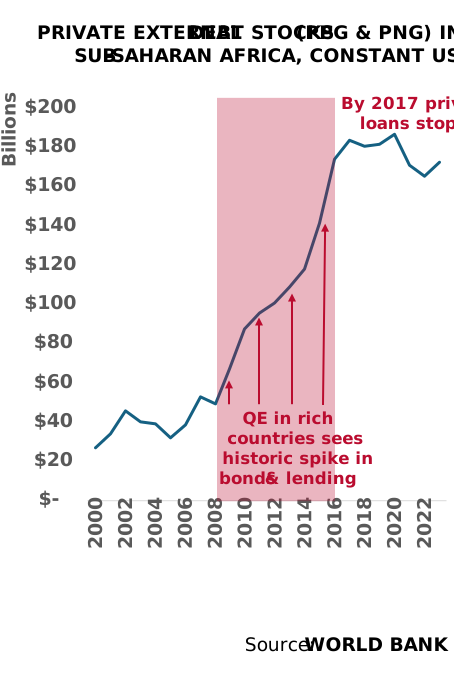
The origins of the debt crisis are from the period of reckless lending after the first rich country ‘Quantitative Easing’ (QE), when several high income governments created new money to prevent a liquidity crisis in their countries 15 years ago.
There have been two major rounds of QE by rich countries this century, the first in 2008-2011 was over $2.5 trillion in the US and UK alone [1] and the second during the COVID pandemic was over $5 trillion in high income countries [2]. These are not trivial sums, the latter round helped increase the entire global money supply by 30 percent in just two years [3].
The knock-on effects on Africa are shockingly under researched but it is clear the first QE issue in 2008-2010 led to artificially cheap credit.
When rich country governments bought their own government’s bonds via their country’s banks, it boosted their banks’ income to a huge extent.
These banks sought to utilise their trillions in extra resources and so there was a huge rush in rich country banks lending money by purchasing bonds across the developing world.
The price of borrowing fell dramatically and as the graph shows, the volume of African government debt owed to private companies rose rapidly more than doubling in under 4 years.
It was a reckless level that could not withstand interest rates later returning to normal.
There was also extra lending by multilaterals and other governments with China in particular joining high income countries in lending large amounts.
African Governments were culpable but no more than others, the increased borrowing in African developing countries was less than non-African developing countries in total and per person.
As the effects of Quantitative Easing wore off, interest rates started to climb from 2015, particularly for African countries who were vulnerable because so much of the economic return from the African debt funded investments had been taken out of Africa by profit shifting and tax evasion.
By 2017 new lending stopped and the graph flattens.
Even this interest rate rise may have been manageable but African countries were then hit by a succession of international crises, all originating outside of the continent, which drove up interest rates to unrepayable levels.
There are four main factors to consider:
1) How did the World’s Unequal Response to COVID 19 affect African debt?
Everyone was affected by the COVID 19 pandemic, but the world’s unequal response ensured Africa suffered twice over.
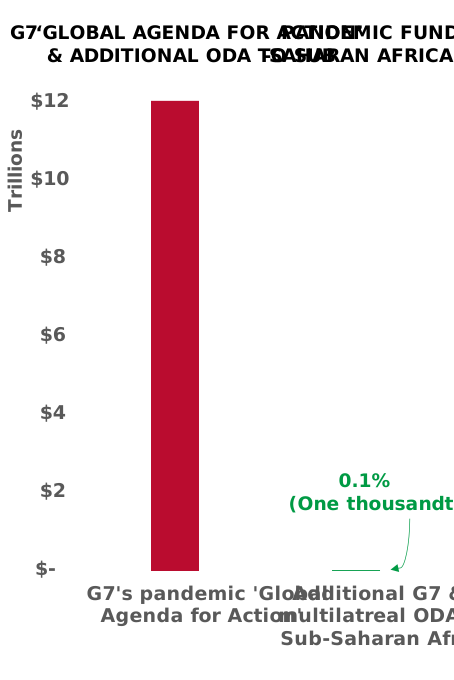
Sub-Saharan Africa was shockingly ignored in the G7’s $12 trillion ‘global agenda for action’ [4] pandemic response, receiving just 0.1% of it in increased aid (ODA) in 2020 [5]
The airline industry bailout alone was six times larger [6]. For just one week of the G7’s COVID emergency funding, all low-income country debt could have been cancelled [7], but it was not.
Instead, rich countries hoarded vaccines whilst simultaneously choosing to reject African requests to at least share how to make the vaccines (India and the then US government agreed but it was blocked by Germany, UK and Switzerland for over a year). [8]
The ‘skyrocketed’ [9] revenues of rich country Pharma companies that year may be why; together Moderna, BioNTech and Pfizer made $1,000 profit every second in 2021. [10]
Humanity faced a common enemy like never before with COVID-19, but our response was to leave the poorest countries to fend for themselves and deny African requests to access the medical research.
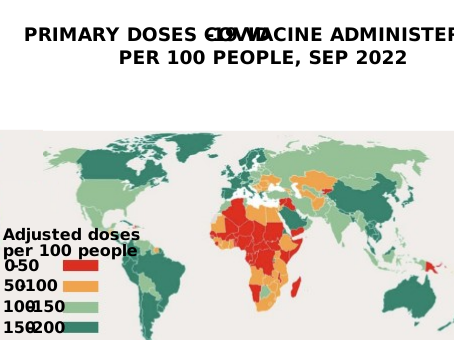
The resultant vaccine apartheid [11] against Africa could not be clearer in this map from September 2022.
It had economic as well as human consequences, decimating the returns from loan investments, ruining entire industries and reducing government revenues.
If the vaccine technology had been shared by rich countries and if the world’s emergency pandemic funding to protect business and people during the pandemic had been allocated more equally the debt crisis would have been averted.
The two billion dollars now leaving Africa every week in debt servicing is more than is spent on education and means millions more African children are out of school but even then it is only enough to perpetuate the debt not repay it.
Many African countries are trapped in debt slavery and unless action is taken to rectify the situation with a one off debt cancellation, young Africans will be paying the price for the world’s unequal response to COVID-19 for decades to come.
“The world faces a catastrophic moral failure in equal access to the tools to combat the pandemic.” Dr. Tedros Adhanom Ghebreyesus, Director-General, World Health Organization, February 2021
2) What impact did the second round of ‘Quantitative Easing’ have on debt?
There was a second set of rich country quantitative easing during the pandemic which has also affected the debt crisis.
Rich country central banks increased the global money supply by 30% [3], but they created the funds only in richer countries and it had consequences for other countries in the world.
As the sovereign debt crisis had begun so lending to Africa did not increase this time (as it did after the 2008 crisis) but the huge growth in the money supply had an inflationary impact “two to four times larger than those of conventional monetary policy”. [12]
The subsequent additional rise in US interest rates to counter the inflation, caused a major depreciation in the value of African currencies which fell by a sixth in just 18 months between January 2022 and July 2023. [13]
With 60 percent of public debt held in USD [14], this alone led “to the region’s rise in public debt by about 10 percentage points of GDP on average” [15] in 2022. This was the average, many individual countries were affected much more than this.
It is clear that rich country quantitative easing has significantly increased the debt crisis in Africa; this must be acknowledged and this portion must be cancelled by the countries responsible. Rectifying it would only be a tiny proportion of the sums involved for rich countries, less than 1%, but it would make a transformative difference to the countries in Africa who were affected.
3) How the Special Drawing Rights (SDR) discrimination has affected the debt crisis?
The effect of quantitative easing might not have been so one sided if all countries were able to increase their money supply.
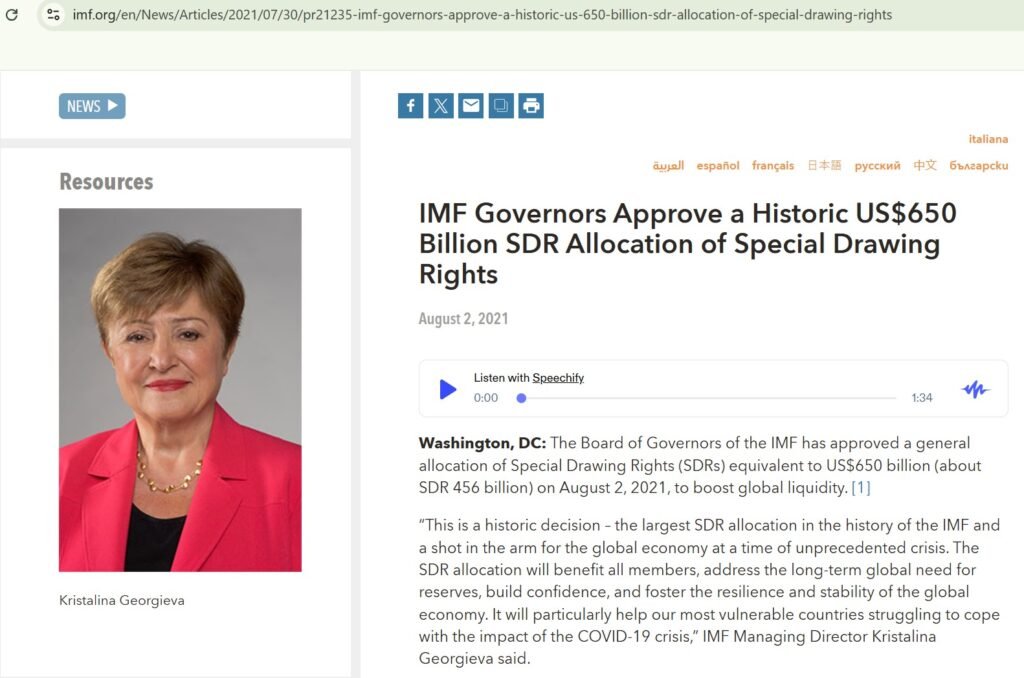
The IMF recognised that lower-income countries, who also had a liquidity crisis, could not do this so the IMF decided to act like a central bank for the world and issue $650 billion in Special Drawing Rights (SDRs) to help.
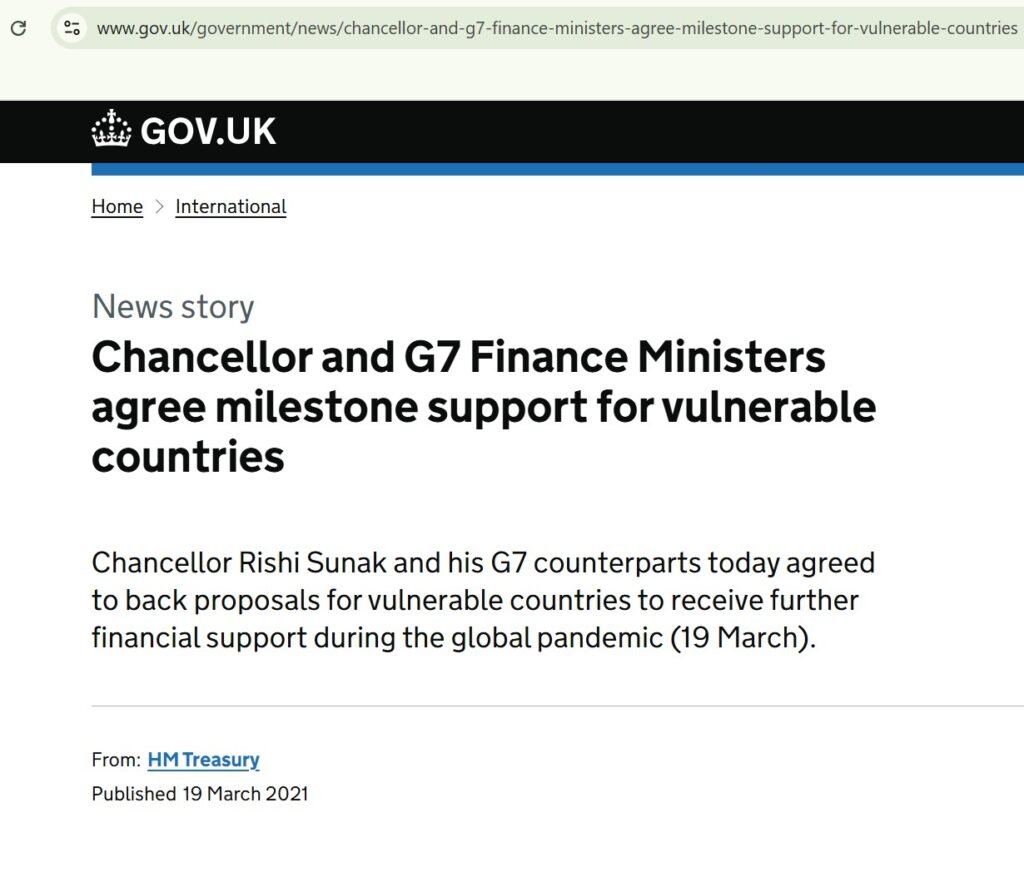
IMF Managing Director, Kristalina Georgieva stated “It [an emergency SDR issue] will particularly help our most vulnerable countries struggling to cope with the impact of COVID-19” [16] and the UK government boasted about the milestone support agreed for vulnerable countries. [17]
Though it was a far smaller amount of money than the trillions rich countries created for themselves, it was still significant and looked like much-needed good news for low-income countries during the pandemic.
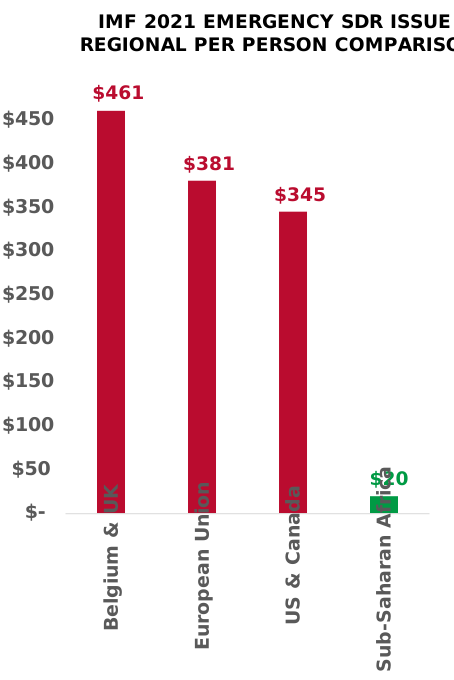
However, despite boasting about supporting vulnerable countries the UK, and the other rich countries that control the IMF, decided shamefully to keep most of the money for themselves.
The graph shows how much the SDR allocation was worth per person, $20 per African and 19 times more per European. [18]
The IMF Managing Director and French President deserve credit for trying to persuade rich countries to then reallocate some funds back to lower income countries but this was only a small proportion, under IMF control, took two years to agree and even now many countries haven’t done it.
Even if they eventually do the limited reallocation, African per person IMF allocations will still be less than 10% of Europeans [19] (way below the infamous US three-fifths clause) [20].
When the IMF acts like a central bank for the world, creating money with an emergency issue of SDR, allocating it unequally like this is discrimination. It should have been ringfenced for lower income countries, or distributed by population, but it was not.
Who made this decision? The very same rich countries who benefited. High income countries have enough votes to control the IMF. For example, the UK and Belgium alone have more IMF votes than all the 48 sub-Saharan African countries put together, as they have since the IMF was founded in colonial times [21].
This was not only immoral but made the debt crisis much worse; by not allocating SDRs equally African countries lost out on $83 billion [22].
Indeed If the SDRs had been ringfenced for the low and lower middle-income countries unable to do QE, African countries would have received $192 billion, enough to cancel all low-income country debt in Africa [23].
It is an injustice that can and must be corrected by a balancing SDR issue so that all countries get the same per capita share.
4) What Impact did the Invasion of Ukraine have on Africa?
The fourth major driver of the debt crisis in Africa has been Russia’s invasion of Ukraine which has had major consequences, further driving up inflation in commodity, fuel and food prices [24].
In East Africa, the World Food Programme reported the price of a local basket of food had increased by more than 55 percent in a year [25] following the invasion of Ukraine.
It caused the “greatest global food security crisis of our time” [26]. It should also be noted this was also exacerbated by the worst droughts in four decades that “would not have been possible without climate change” [27] (the climate crisis which Africa is not responsible for has certainly also exacerbated the debt crisis in Africa).
A 2024 ODI report on the impact of the Russia-Ukraine war on Africa, estimates African annual GDP losses will be greater than $7 billion and that “Global commodity price increases also prompted an increase in interest rates in high-income countries, which in turn triggered capital outflows, exchange rate depreciation and higher borrowing costs for many African countries” [28]. Apart from the tragic loss of life in the fighting, the war has undoubtedly contributed to the debt crisis in Africa.
A Debt Crisis Created Outside of Africa
It is clear this is a debt crisis mainly caused by factors outside of Africa.
Many African governments should not have borrowed that scale of money, but the returns on the investments have been devastated by these major factors outside of African government control.
Sometimes by design, sometimes by indifference, the actions of the richest countries have created in the last decade the largest debt crisis in history and young people in Africa are paying the price.
The IMF, and the rich countries controlling the IMF, must recognise their role and the exceptional circumstances and support an emergency SDR release to cancel the debt.
Sources
REFERENCES:
1. Federal Reserve Bank of St Louis ‘Quantitative Easing: How Well Does This Tool Work?’ (August 2017) – Read more here – shows $2.025 billion in QE programmes from the Fed from December 2008-June 2011 & House of Lords Economic Affairs Committee ‘Quantitative easing: a dangerous addiction?’ – Read more here – p.11 shows for the UK £375 billion by July 2012.
2. House of Lords Economic Affairs Committee ‘Quantitative easing: a dangerous addiction?’ – Read more here – Chapter 3 states “In 2020, the Bank of England conducted three rounds of quantitative easing, which raised the total amount of Government debt owned by the Bank from £425 billion to £875 billion (an increase of £450 billion) & in chapter 1, paragraph 12 “Outgoing Bank for England Chief Economist Andy Haldane estimated “central banks have expanded their balance sheets by approximately $5.5 trillion since 2020” & this is in proportion with US Federal Reserves ‘Recent balance sheet trends’ – Get data here & European Central Bank ‘Pandemic emergency purchase programme (PEPP)’ Get data here – detailing programmes in the EU & Sydney Morning Herald – ‘RBA to End Big Spending QE Program as Inflation Pressures Grow’ – Read more here detailing A$337bn in Australia & University of Toronto Press ‘The Fiscal Impact of Quantitative Easing’– Read more here – detailing C$400 in Canada.
3. TradingView, ‘Global (World) Monetary Supply M2 (measured in SD)’ – Get data here – Comparing $79 trillion in March 2020 with $103 trillion in 2022.
4. The White House ‘CARBIS BAY G7 SUMMIT COMMUNIQUÉ’, (13th June 2021) – Read more here
5. OECD/DAC, ‘Table 29. Net Disbursements of ODA to Sub-Saharan Africa by Donor’ – Get data from archive here gives $55.1 billion for 2019 and $67.8 billion for 2020 an increase in ODA to sub-Saharan Africa of $12.7 billion in 2020 around 0.01% of the G7 $12,000 billion.If the 2021 uplift was included it was 60% smaller at $5.1 billion so still only 0.014% G7 Global Agenda for Action & OECD ODA ‘Net ODA’ – Read more here – stands for Official Development Assistance and is defined as government aid designed to promote the economic development and welfare of developing countries.
6. BBC News, ‘Airline industry needs up to another $80bn to survive pandemic’ (17th January 2021) – Read more here Director-General Alexandre de Juniac told the BBC that sum was “on top of the $170bn already granted” & OECD/DAC data in [5]
7. IMF ‘Central Government Debt (Percent of GDP)’ Get data here & World Bank, ‘GDP Total Current – NY.GDP.MKTP.CD’ – Get data here gives total African low-income debt of $194.23 billion in 2022 and less in 2020 . One week of the $12 trillion G7 Global Agenda for Action (Ibid) was worth $230.77 billion.
8. Reuters ‘Germany rejects U.S. proposal to waive patents on COVID-19 vaccines’, (May 2021) – Read more here & House of Commons Library ‘Waiving intellectual property rights for Covid-19 vaccines Research Briefing’ (13th July 2022) – Read more here & The Bureau Of Investigative Journalism, ‘Who Killed the Vaccine Waiver?’ – Read more here
9. Fierce Pharma ‘The top 20 pharma companies by 2021 revenue:’ Read more here
10. Oxfam International ‘Pfizer, BioNTech and Moderna making $1,000 profit every second while world’s poorest countries remain largely Unvaccinated’, (2022), Read more here
11. The Economist, ‘Cyril Ramaphosa says the world must end vaccine apartheid’, (Nov 8th 2021) Read more here
12. Centre for Economic Policy Research (CEPR) ‘Quantitative easing generates more inflation Centre for Economic Policy Research (CEPR) ‘Quantitative easing generates more inflation than conventional monetary policy’, (3rd January 2024) Read more here
13. & 14. & 15. ISS African Futures with AUDA-NEPAD, ‘Exchange rate pressures take a toll on sub-Saharan Africa’ (2nd August 2023) – Read more here , “Most currencies in the region have weakened significantly against the US dollar – the key currency for trade invoicing and external debt – with average depreciation of 16% between 1 January 2022 and 20 June 2023” & African Business, ‘Why African currencies are struggling’, (20th September 2022) – Read more here – gives a more detailed breakdown for individual currencies. “About 40% of public debt is external in sub-Saharan Africa and over 60% of that debt is in US dollars for most countries.” and “Since the beginning of the pandemic, exchange rate depreciations have contributed to the region’s rise in public debt by about 10 percentage points of GDP on average by end-2022, holding all else equal”
16. International Monetary Fund , ‘Press release: IMF Governors Approve a Historic US$650 Billion SDR Allocation of Special Drawing Rights’, (2 August 2022) – Read more here (accessed 24 October 2022)
17. HM Treasury, UK Government, ‘Chancellor and G7 Finance Ministers agree milestone support for vulnerable countries’ (19 March 2021) – Read more here (accessed 24 October 2022)
18. International Monetary Fund ‘2021 General SDR Allocations’ Get data here & World Bank ‘Indicator: Population, Total – SP.POP.TOTL’ – Get data here
19. Calculations reallocating 15% of SDRs using data from [18]
20. Thirteen.org ‘The U.S. Constitution‘ – Read more here
21. IMF ‘IMF Executive Directors and Voting Power’, (28th June 2024), Get data here
22. IMF, ‘2021 General SDR Allocation’, (23rd August 2021), Get data here – Calculation done on an allocation on population which is equivalent to $82.57 per person for the world instead of the $23.72 per African actually received (total 23,734 SDR worth a then $33.79 billion). This gives a total of $117.65 billion for a fair allocation an increase of $83.85 billion in SDR funding.
23. IMF, ‘2021 General SDR Allocation’, (23rd August 2021), Get data here – Calculations ring fencing the $650 billion for low and lower middle income countries would allocate $168.05 per person & World Bank ‘Indicator Population, total, SP.POP.TOTL’ – Get data here – gives 1.14 billion people in low-income and lower-middle income sub-Saharan countries. So SDRs worth $191.69 billion.
24. British Red Cross, ‘Africa food crisis: more than 150 million people going hungry’, (7th December 2023), Read more here
25. Centre for Strategic and International Studies, ‘Russia, Ukraine and Global Food Security: A One Year Assessment’ (24th February 2023) – Read more here
26. BBC News quoting US Secretary of State Antony Blinken ‘Ukraine invasion could cause global food crisis, UN warns’ (19th May 2022) – Read more here
27. Financial Times, quoting World Weather Attribution Group, ‘Horn of Africa drought made 100 times more likely by climate change, scientists report’ (27th April 2023) – Read more here
28. ODI, ‘Impact of the Russia– Ukraine war on Africa’ (2024), Read more here
Justice for Africa
Justice for Africa: Don’t Cut Our Future is an African youth- and student-led global campaign demanding an end to this injustice.